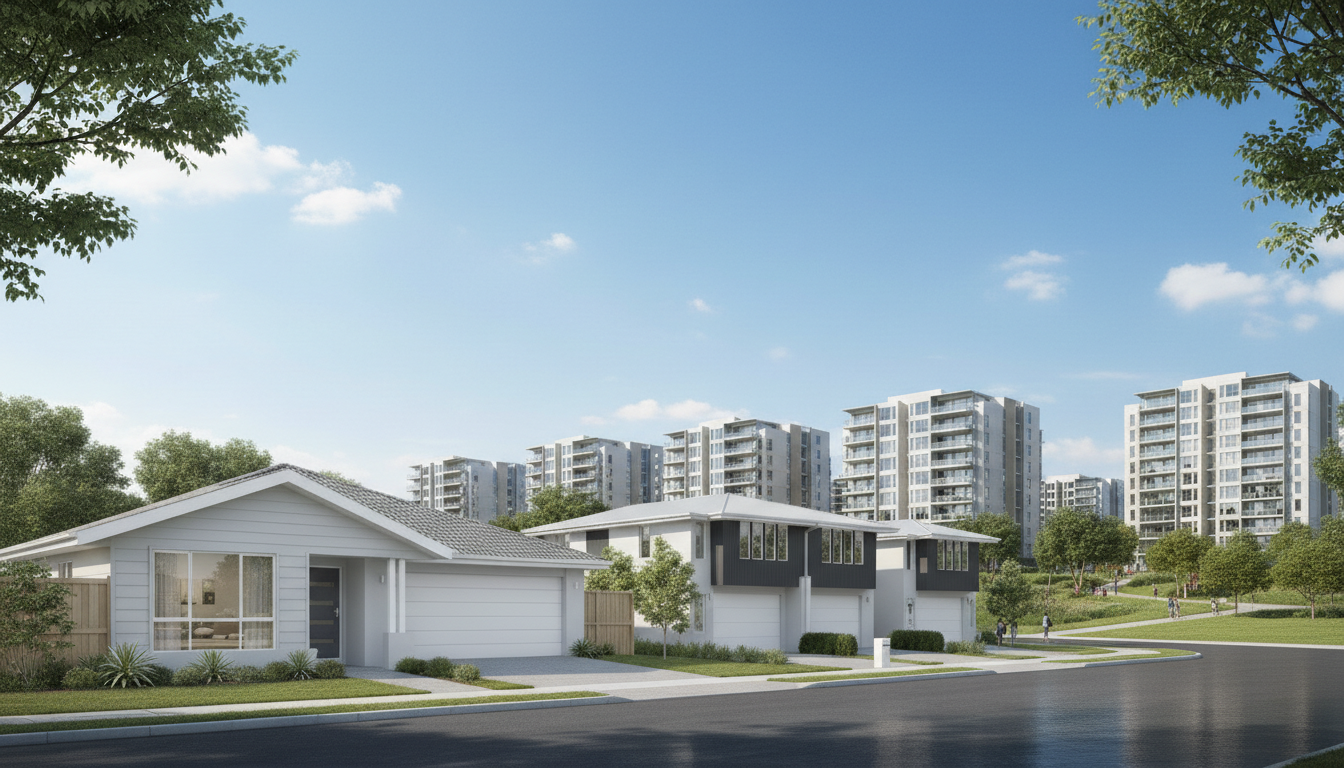
In 2026, the Australian property market is no longer a simple race where “land always wins.” For decades, the mantra was that a freestanding house on a big block was the only path to wealth. But as we navigate a landscape of high construction costs, a chronic housing shortage, and a “two-speed” market, the rules have changed.
Whether you’re a first-home buyer trying to break the rent cycle or an investor looking for yield, here is how House & Land, Townhouses, and Units stack up in today’s market.
1. House & Land: The “Blue Chip” Capital Growth Play
Traditionally, the “Great Australian Dream” is built on the fact that land appreciates while buildings depreciate. In 2026, this remains true for long-term wealth, but the entry price has reached an all-time high.
- Market Status: Standalone houses in major capitals like Sydney and Melbourne now command a massive price premium—often 70% higher than the median unit price.
- The 2026 Edge: Scarcity is your best friend. With councils pushing for higher density, a freestanding block in an established suburb is a “limited edition” asset.
- Best For: Long-term investors (10+ years) and families who prioritize privacy and the freedom to renovate.
Pro Tip: In 2026, “House & Land” packages in outer-growth corridors are seeing slower growth than houses in “middle-ring” suburbs. Focus on locations with established infrastructure rather than just new grass.
2. Townhouses: The “Goldilocks” Solution
Townhouses have emerged as the MVP of the 2026 market. They offer a middle ground: more space than an apartment, but more affordable than a house.
- Market Status: Townhouses are currently outperforming houses in “pull-through” demand. When buyers are priced out of houses, they don’t go to units—they go to townhouses.
- The 2026 Edge: They hit the “sweet spot” for the two largest buyer demographics: Downsizers (who want low-maintenance luxury) and Young Professionals (who want a home office and a small courtyard).
- Best For: Those who want a “lock-and-leave” lifestyle without sacrificing the feeling of a “real” home.
3. Units/Apartments: The Yield & Affordability King
2026 has been a “comeback year” for the humble unit. With national vacancy rates hovering near record lows (below 1% in cities like Perth and Brisbane), units are no longer the “compromise” choice.
- Market Status: In many LGAs, unit price growth is actually outpacing houses. For example, in Brisbane and Perth, over 75% of unit markets matched or beat house growth in the last year.
- The 2026 Edge:Rental Yield. Units typically offer gross yields of 4.5% to 6%, significantly higher than the 3% to 3.5% seen in houses. This makes them much easier to “hold” as interest rates fluctuate.
- Best For: Cash-flow-heavy investors and first-home buyers using government schemes (like the First Home Guarantee) to enter the market with a smaller deposit.
Comparing the Three: At a Glance
| Feature | House & Land | Townhouse | Unit / Apartment |
| Price Point | Highest | Mid-range | Most Affordable |
| Capital Growth | High (Land-driven) | Strong (Demand-driven) | Moderate (Location-driven) |
| Rental Yield | Lower (~3.5%) | Solid (~4.2%) | Highest (~5%+) |
| Maintenance | High (Your responsibility) | Low (Body Corporate) | Very Low (Strata) |
| Control | Full Autonomy | Limited by Bylaws | Strict Strata Rules |
The Verdict: What works best in 2026?
The “best” choice depends on your Exit Strategy:
- If you want to build massive equity over 20 years: Stick with House & Land. The land component is a hedge against inflation and a finite resource in our growing cities.
- If you are a First Home Buyer in a capital city: Look at Boutique Townhouses. They offer the best balance of lifestyle and future resale value without the $1.5M+ price tag.
- If you need cash flow to service your mortgage:Units in “walkable” suburbs (near cafes, transport, and hospitals) are the winners. Avoid high-rise “cookie-cutter” towers; focus on boutique blocks with low strata fees.
The Golden Rule for 2026: Location and scarcity now matter more than the dwelling type. A well-located unit in a prime suburb will likely outperform a house in a remote suburb with no public transport.
